Retaining Structures
Services
Retaining Structures
Retaining Structures
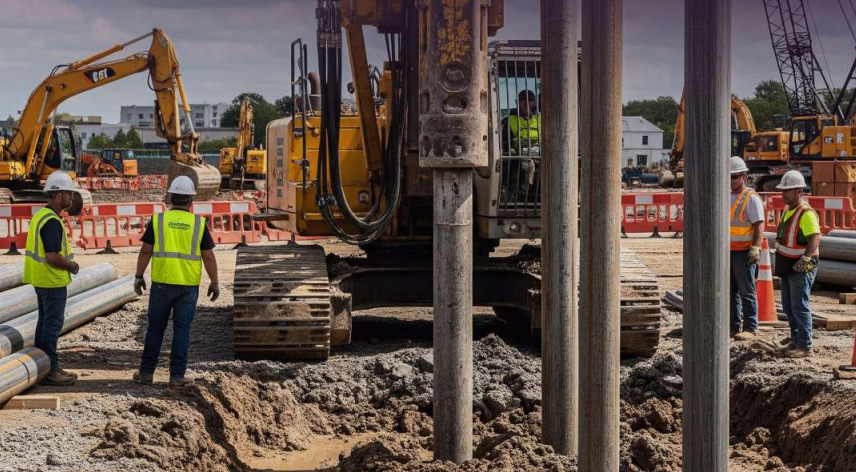
We provide pile shoring systems designed to retain soil, rock, and groundwater during excavation. These retaining structures are formed by sequentially installing piles along the site perimeter. The design is tailored based on excavation depth, ground conditions, external loads, and deflection limits, and can be customized for either temporary or permanent use.
Diaphragm walls are reinforced concrete walls constructed in deep excavations, either cast in situ or with precast components. Ideal for congested sites with limited headroom or deep excavations, these walls minimize vibration and noise, making them suitable for use near existing structures.
Constructed in panel lengths ranging from 2.5 to 7 meters and depths exceeding 50 meters (up to 80 meters with hydromill technology), diaphragm walls are supported during excavation using bentonite slurry to maintain trench stability. They can be designed with connections for floor slabs and integrated joints with water bars.
Diaphragm walls are commonly used in deep basements, underground stations, shafts, and tunnel approaches. While relatively high in cost, they are highly effective when incorporated as part of permanent building structures.
This system involves closely spaced bored concrete piles for earth retention. While not fully water-tight, performance can be enhanced with dewatering, shotcreting, or grouting. Piles are cast alternately to ensure stability, with reinforcement based on design needs. The system may act as a cantilever or be supported with tie-backs or props, and typically includes a reinforced concrete capping beam.
Bored Secant Pile Walls :
Secant pile walls are formed by overlapping bored concrete piles to create a more water-tight retaining structure compared to contiguous pile walls. Typically, unreinforced primary piles are cast first, followed by reinforced secondary piles using higherstrength concrete. Water-tightness can be further enhanced with shotcreting, grouting, or surface repairs. This system is ideal for deep excavations and areas with high groundwater levels.
Sheet pile shoring systems are flexible, hot-rolled structural steel retaining walls available in various shapes, dimensions, and strengths. Common types include Larsen, Z, U, and angled sections, typically made from mild or high-tensile steel, and designed for environmental suitability. Sections are usually 12m long and can be cut or spliced to required lengths. These piles interlock to form a water-tight wall, which can be enhanced with mortar or grout. The installation process involves using a steel guide frame for alignment and verticality, with hydraulic vibratory hammers for driving. Sheet pile walls can be cantilevered or supported by tie-b
Soldier pile walls use I/H steel beams driven into predrilled holes and backfilled with gravel. Timber or precast panels are placed between beams to form the wall. These walls can be cantilevered or supported with braces/tie-backs, depending on ground conditions. Typically for excavations up to 7.5m, they require dewatering as they are not watertight. Once construction is complete, temporary piles are extracted.